How Parlor Games Shaped Leisure at Home
Learn how parlor games shaped organized leisure at home, and use their simple rules, shared attention, and flexible structure to plan a gathering.
The common mistake in planning leisure at home is treating a game as the whole event; the cost is that the host can end up performing while guests wait for direction. Parlor games offer a different lens: they made the room itself part of the occasion, with conversation and shared attention doing much of the work. That approach still helps explain how organized leisure at home can feel inviting rather than imposed.
Parlor games used the room as their playing field
Parlor games are often associated with wordplay, guessing, charades, and music. These activities needed little beyond a group, a place to gather, and a willingness to take part. Their appeal was not elaborate equipment; it was the way a familiar room could become a setting for a shared pastime.
The format also gave a gathering a loose structure. Someone could explain a simple rule, start a round, and let the group decide whether to continue. When interest faded, the activity could give way to conversation without a large setup to dismantle.
That ease had a tradeoff: the person leading the game could become responsible for carrying the whole evening. A useful principle is to choose an activity that does not require one guest to keep supplying the energy.
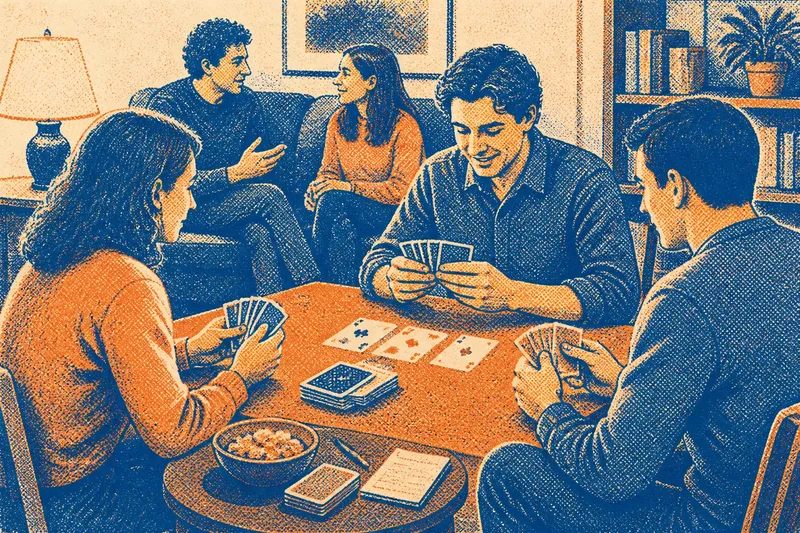
Say you are hosting friends who have not all met. You put a deck of cards and a few word prompts on a side table, then mention that anyone can try them if conversation slows. The expected result is a visible invitation people can accept or ignore, rather than a program everyone is expected to follow.
Parlor games shaped organized leisure at home
The parlor-game tradition offers a way to think about organized leisure at home without claiming that every household or gathering followed one pattern. In this format, a host could give an evening a focal point while keeping the activity close to ordinary conversation. The room remained a social space, not just a stage for a performance.
That balance distinguishes a home pastime from an event built around a single attraction. A parlor game could start and stop with the group’s interest; a formal performance or scheduled outing tends to ask guests to follow its timing. The difference is less about which format is better than about how much structure the company wants.
For a gathering at home, borrow the flexible rhythm rather than trying to recreate a historical scene. Keep materials easy to reach, explain the activity plainly, and let the group decide whether it becomes the evening’s focus.
How can you adapt parlor games for a gathering?
What makes a parlor game easy to join?
Choose a game whose rules can be explained in a few sentences and whose first round shows how it works. Let guests watch before joining, so participation does not depend on an immediate performance.
How do you keep the host from carrying the evening?
Use an activity that can continue without constant prompting, such as a familiar card game or a simple word-guessing round. If the group loses interest, pause it and let conversation take over.
What materials do you need for a home game?
Many options use ordinary items, such as a deck of cards, paper, pencils, or spoken prompts. Pick materials that suit the activity, then place them where guests can see them without interrupting conversation.
How can a game end without making the gathering feel awkward?
Finish the current round, thank everyone who played, and leave the materials aside. A clear ending makes it easy to move on to conversation or refreshments without treating the change as a failure.
Choose activities with clear starting and stopping points
For organized leisure at home, a small amount of structure can make an activity easier to approach. Check these details before choosing a game; each observation points to a practical decision.
- Rules: Check whether the instructions fit into a brief spoken explanation. If they do, then offer the game; if not, choose a simpler activity or set out a written guide.
- Materials: Check that the required items are already available or easy to prepare. If they are, then place them within reach; if not, choose a game that uses what you have.
- Group size: Check whether everyone can hear the instructions and see the play area. If they can, then start together; if not, split into smaller rounds or pick a conversation-based game.
- Participation: Check whether someone can watch before joining. If they can, then explain that option; if not, choose a game that allows people to enter between rounds.
- Personal comfort: Check whether play requires sharing private details or performing alone. If it does, then offer an alternative or choose a game that keeps the focus on words, objects, or teamwork.
- Ending: Check whether a round has a natural stopping point. If it does, then use that point to pause; if not, agree on a simple end signal before play begins.
Imagine you have six guests, a deck of cards, and a small table in a living room; these are invented example details, not historical claims. You check the rules and choose a familiar card game that can be explained before the first hand; you check the table and find that only four people can play comfortably at once; you decide on two short rounds, with watching welcome, rather than trying to seat everyone. You set the deck on the table, explain that the game ends after the second round, and begin. The resulting tradeoff is clear: some guests play while others talk or watch, and the gathering has a defined stopping point without requiring everyone to participate.
Let the pastime remain smaller than the occasion
Parlor games show how a simple activity can give a home gathering a shared focus without claiming every minute of it. Their most useful lesson is practical: make the invitation understandable, keep the activity easy to pause, and let the people in the room shape how long it lasts.
When choosing parlor games for organized leisure at home, consider the room as well as the rules. A table, a deck of cards, and a clear stopping point may be enough to begin; the next useful decision is to leave the materials accessible after the game ends, so guests can return to them only if interest remains.